flowchart LR
accTitle: The retrieval pipeline
accDescr: Flowchart in two columns. Left column, when you add a source, your PDF is chunked into passages, each passage is embedded as a list of numbers, and the numbers are indexed. Right column, when you ask a question, the question is embedded and the nearest passages are retrieved from the index, those passages are pasted into the context window, and the model generates an answer pointing at them.
subgraph I["When you add a source"]
direction TB
doc[Your PDF] --> chunk[1. Chunk: cut into passages of a few hundred words]
chunk --> embed[2. Embed: turn each passage into a list of numbers]
embed --> index[3. Index: store the numbers so similar ones are findable]
end
subgraph Q["When you ask a question"]
direction TB
q[Your question] --> retrieve[4. Retrieve: embed the question, find the nearest passages]
retrieve --> augment[5. Augment: paste those passages into the context window]
augment --> generate[6. Generate: write an answer, pointing at the passages]
end
index -.-> retrieve
6 Grounding AI in real sources: what a retrieval tool fixes, and what it cannot
About 70 minutes
TipIn short
- The idea. A tool that answers only from documents you give it rarely invents a reference, because every citation points at a passage it was handed. You can now use one to read a set of papers fast, and check any sentence from it in about a minute.
- What you do. Load four papers into Gemini Notebook (formerly NotebookLM), ask for a one-page journal-club brief, and check three of its sentences against their sources.
- What you keep. The checked and corrected brief, and the one-minute check: click the citation, read a line above and below, and ask whether the sentence is narrower or broader than the passage.
- Short on time? Read “Journal club is Thursday”, “What ‘grounded’ means, step by step”, and “The failure grounding does not fix”. Do Steps 1 and 2.
NoteWhat you’ll learn
By the end of this chapter you will be able to:
- Explain what a context window is, and why a chatbot only seems to remember your conversation: the whole conversation is sent again every turn.
- State plainly that a language model does not learn from you, and say what does change between one turn and the next.
- Describe the six retrieval steps in order: chunk, embed, index, retrieve, augment, generate.
- Explain why a tool that answers from your sources invents citations far less often than a general chatbot, and why that comes from how it is built rather than from care.
- Catch the error that grounding does not fix: a real, correctly linked source that the summary has misread or stretched too far.
- Build a notebook from sources you chose, use it to write a brief you have checked, and say when that is and is not a literature search.
Course competencies: AIM-1 (foundations), AIM-2 (critical appraisal), AIM-9 (research and scholarship).
What you need. A Google account for Gemini Notebook (a personal Gmail account works; see “Getting in” in the Do), and your university ChatGPT Edu or Copilot account in a second tab. Nothing to install. Made-up patients only. The time is about 15 minutes of reading, 7 of video, 35 to 40 of doing, and 10 for the check and the closing question.
6.1 Journal club is Thursday
You are three weeks into a sub-internship. The chief resident hands you a paper to present at Thursday’s journal club, and four more “for background.” The topic is whether AI tools that answer from a set of documents are ready for the clinic, and she knows you have opinions. It is Monday. You have five PDFs, two call shifts, and a personal statement to finish.
A co-intern says: put them all into Gemini Notebook and ask it your questions. (Google renamed NotebookLM to Gemini Notebook on 16 July 2026. Papers and colleagues still use the old name.) A tool like this answers only from the documents you give it. Ask it about the guideline paper and you get something like this.
Did adding retrieval improve the accuracy of the language models on the guideline questions, and did it work for all the models?
Adding guideline retrieval improved accuracy across all models, with a pooled gain of +0.64 points (95% CI 0.47–0.80) on the automated judge.1 The benefit was largest for weaker models, with Mistral, Qwen3, and GPT-OSS showing gains of +0.72 to +0.94 points, but modest or absent for already-strong models like DeepSeek and GPT-5.1 Additionally, hallucination rates plummeted from 42% to 4% consistently across all base models when retrieval was enabled.1
1 · Vollmer et al., Diagnostics 2026 · Results, Table 6. Illustrative: not Gemini Notebook output. A different tool that also answers only from the source it is given (Claude, reading the paper’s web page) wrote this on 2026-09-07; the callout “Where the opening answer came from” below has the details.
Every number in that answer is real. Every little blue “1” links to a passage that exists. The first sentence is going on your slide. But the first sentence is broader than the paper. The paper says the gain was statistically significant in three models and only “directional” in the two strongest: a trend that could be chance.
This chapter is about why the numbers are real, why the sentence drifted, and how to tell in about a minute. Two words first, because vendors use both. A grounded tool is one that answers from documents it was given and points back to them. Retrieval is how it finds the right passages in those documents before it writes.
6.2 Why this matters
In residency you will read less than you do now and rely on summaries more. Tools like this one will write many of them: a notebook built from a rotation’s reading list, a literature tool that searches PubMed, a tool inside the EHR that answers from your hospital’s protocols. Used well, they are fast and accurate. In one study, four orthopedic specialists rated 50 disability cases against a written regulation. With NotebookLM they were right 91% of the time, against 68% working by hand, and finished each case more than three times faster (Duran et al., 2026).
These tools “cite their sources”, and that is a real advance. What citing protects you from, and what it does not, follows from how the tool works. When a notebook misreads a paper, the result is a wrong slide. When the grounded tool inside the EHR misreads a protocol, the result can harm a patient. The clinician who repeated the sentence is responsible for it.
6.3 How it works
6.3.1 The model has no memory
Start with something you can see. Open a chatbot and ask it who won the 2020 World Series, the baseball championship. It answers: the Dodgers. Ask “where was it played?” It answers correctly: Arlington, Texas, because of the pandemic. It seems to remember the first question.
It does not. Here is what the model actually received on the second turn:
[user]      Who won the 2020 World Series?
[assistant] The Los Angeles Dodgers won the 2020 World Series ...
[user]      Where was it played?
The entire conversation is sent again, every turn. The model then writes the next piece of text given all of it. That block of text is the context window: everything the model can see at the moment it answers. It is measured in tokens, which are words or pieces of words, and it has a fixed size. When you close the tab, the context is gone. The model is exactly what it was before you opened it.
So a language model does not learn from you. Nothing you type changes the model’s weights, the billions of numbers set during training that make it what it is. What changes between turns is the context. “It got better as we talked” means “the context got longer.”
Two things can look like learning, and neither is. Some chatbots, ChatGPT among them, have a memory setting that saves notes about you and pastes them into later chats. And the company may store what you type; some consumer accounts let it train the next model, months later. Both are about how your data is handled. That is why the course rule is about what you type in.
The context window has a fixed size, and the model does not read all of a long one equally well (Go deeper has the study). A retrieval tool’s whole job is to choose the few passages that go into it.
6.3.2 What “grounded” means, step by step
A general chatbot writes a reference the way it writes everything else: as likely-looking text. That is how it can produce a reference that looks right and does not exist. A retrieval tool searches first and writes second. The search-first way has six steps. Together they are the retrieval pipeline, and each step is a place where something can go wrong. Google does not publish exactly how Gemini Notebook does each step. The six steps are the general design that tools of this kind follow.
Chunking cuts the document into passages of a few hundred words, because a whole paper will not fit in the context window next to your question and forty other papers. Chunking is simple by design. It cuts on length, not meaning.
Embedding turns each passage into a list of numbers, called an embedding. Passages about similar things get similar numbers. “Apixaban reduced major bleeding” and “less hemorrhage with the factor Xa inhibitor” get numbers that are close together. “The patient’s dog is named Apixaban” does not. You do not need to know more than “similar meaning, nearby numbers.”
Indexing stores those numbers so that, given a new list of numbers, the closest matches can be found in milliseconds.
Retrieval turns your question into numbers the same way and returns the nearest few passages, usually between three and twenty. Augmentation pastes them into the context window, in front of your question, as plain text. Then generation is the ordinary thing a language model does: write the most likely next words. The difference is that now the most likely continuation of “according to the passages above” is something the passages actually say. A citation is a pointer back to a passage that is already in the window.
That is the entire method. The model did not become honest. It was given the answer and asked to paraphrase it.
6.3.3 Why grounded tools invent less
Studies that check citations often score each one on a simple scale. 2: the source supports the sentence. 1: the source is real, but the sentence misdescribes it. 0: the source does not exist as given. In one such study of spine-surgery questions, a tool that searches PubMed directly scored 2 on every citation. The general chatbots did worse, and the worst made up 26% of its references (McLaughlin et al., 2026). The six steps above are the reason.
The guideline study from the opening measured the same effect one model at a time (Vollmer et al., 2026). Five models answered 50 questions from a German guideline on oral cavity cancer, each with and without retrieval of that guideline. Hallucination, the field’s word for made-up content stated as fact, fell from 42% to 4%. Citations that pointed at a real retrieved passage rose from none to between 51% and 89%, depending on the model.
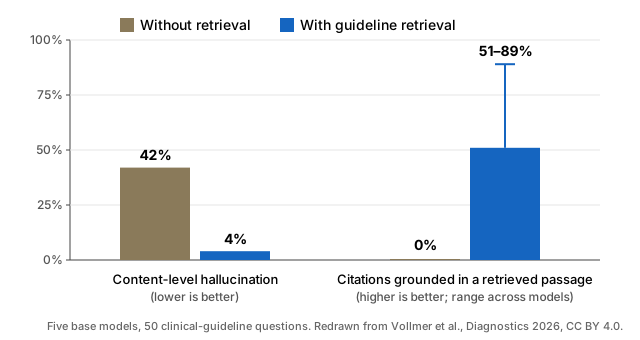
The drop comes from how the tool is built, not from the tool being careful. The same paper found the accuracy gain from retrieval was large for the three weaker models. For the two strongest it was small and not statistically significant. The drop in made-up content, and the gain in checkable citations, held across all five (Vollmer et al., 2026). The authors add that the strong models may simply have been near the top of the scale already. The safer summary is this: grounding does not reliably make a model smarter. It makes it checkable.
A grounded tool can also do something a general one does not: say it does not know. A guideline chatbot for lung cancer was asked about cancers its guideline did not cover. It “consistently declined to answer and indicated that the available information was insufficient” (Nishisako et al., 2026). A general chatbot, asked the same question, writes a paragraph. “I cannot find that in your sources” is the sentence that tells you the tool is doing what it claims. You can try this yourself in Step 4 of the Do.
NoteThese numbers move
Every rate above is one tool, one field, one month. When your own run in the Do disagrees with a number here, that is expected. The pipeline in Figure 6.1 is the part that lasts.
6.3.4 The failure grounding does not fix
Go back to the opening answer. Its sources are real, and its numbers are in the paper’s Table 6. Its first sentence says retrieval “improved accuracy across all models.” The paper says the gain was significant for three models and “small and not statistically significant for the already-strong bases.” The answer’s second sentence half-corrects this. But the first sentence is the one that goes on the slide.
On the 2/1/0 scale this is a score 1: a real reference, described more broadly than it supports. It is the kind of error that grounding, because of how it is built, cannot catch. The pipeline guarantees that the text came from the passages. It does not guarantee that the model read the passages the way the authors meant them. A dentistry study put it this way: the retrieval systems “avoided fabricated references but still generated incorrect interpretations” (Hooshiar, 2025).
The misreading usually goes one way. When 10 widely used models were asked to summarize scientific texts, most produced conclusions broader than the original, even when told to be accurate. Model-written summaries were nearly five times more likely than human-written ones to contain a broad generalization (Peters & Chin-Yee, 2025). “In this subgroup” becomes “in patients.” “Was associated with” becomes “improves.” “Not significant for the strong models” becomes “across all models.” The summary reads better than the paper, and that is the problem.
TipWhere the opening answer came from, and how to catch it
The run. On 2026-09-07 the full text of Vollmer et al., Diagnostics 2026 (Vollmer et al., 2026) was given to a tool that answers only from the page it is given. That tool was a Claude model, the one behind the web-page reader in Claude Code. It was not Gemini Notebook. The question was the journal-club question from the opening: did adding retrieval improve accuracy, and did it work for all the models? The three sentences at the top of this chapter are its answer, word for word. A second run on a different paper (Duran et al., 2026) produced a score-2 answer. That one kept the authors’ own caution that the tool had not been tested at other sites. The misreading is not inevitable. It is common.
The check. In a notebook, clicking the citation shows you the passage. Here, open the paper and find Table 6. Two of the five confidence intervals cross zero, which means the gain for those two models may be nothing. That is the whole check. Read one line above and one line below the passage: the line below is where the “however” usually is.
NoteIf you have more time: what chunking does to a table
Take a results table in a paper you uploaded. To the tool it is a few lines of text. If a chunk boundary falls inside it, the tool stores something like the block below. It is built from Table 6 of the guideline study and the sentence that describes it. The cut and the layout are made up; it is not a screenshot of any tool.
chunk 7 of 23...

Table 6. Within-model effect of guideline retrieval (automated judge).

Model             Base      +RAG    Δ accuracy (95% CI)
Mistral Small     3.40      4.34    +0.94 (0.58–1.30)
Qwen3-Next        3.52      4.38    +0.86 (0.50–1.22)
chunk 8 of 23GPT-OSS-120B      3.62      4.34    +0.72 (0.36–1.08)
DeepSeek-V3.2     4.08      4.44    +0.36 (−0.01–0.72)
GPT-5-chat        4.18      4.48    +0.30 (−0.07–0.66)

The gain was large for the weaker models and small and not statistically significant for the already-strong bases ...
Chunk 8 has the rows that matter for the question in the opening scenario. Chunk 8 has no column headings. When it is retrieved alone, the model sees five numbers per line and has to guess what they mean. When only chunk 7 is retrieved, the model sees the headings and the two rows where retrieval helped most. It never sees the sentence that qualifies them. Both chunks are real. Both citations will resolve. Neither is the table.
Nothing in the basic pipeline knows that a table is a table, or that “not statistically significant” three lines later applies to the number above it. Better tools try to keep tables whole, and from the outside you cannot tell how well yours does. These are errors of reading, made on a source that is real.
6.3.5 Three more things grounding cannot see
The pipeline answers from what you gave it. That sets three limits, and no citation link will show you any of them.
The source set. A confident summary of five weak papers is a confident summary of five weak papers, with perfect citations. To trust the notebook, you have to trust what you put in it. Judging the papers themselves is the subject of Critical appraisal.
What is missing. A notebook cannot cite a paper it does not contain. It will not tell you that the trial that would change your mind was published last month and is not in your five PDFs. That is the difference between a grounded search and a systematic one, a search that tries to find every relevant paper. The tool is very good at reading a defined set of documents. It is the wrong tool for what does the literature say, because there the papers you failed to include are the ones that matter.
Disagreement. When two sources disagree, retrieval pulls passages from both, and generation writes one paragraph. The result can be one blended answer that no source holds, with the disagreement smoothed away. You will test whether your tool does this in Step 3 of the Do, with two papers chosen because they disagree about the same tool.
ImportantThe practical rule
A grounded tool fixes the reference. It helps you see where each sentence came from. It does nothing for the claim itself. So: for any sentence you will repeat, click its citation, read a line above and below, and ask whether the sentence is narrower or broader than the passage. Broader is the usual direction. The tool is a way of finding your way through sources. It is not a source. The citation on your slide is the paper, and you have now read that part of it.
6.4 Watch or listen
Video. IBM Technology, “What is Retrieval-Augmented Generation (RAG)?”, presented by Marina Danilevsky (23 August 2023; 6 min 36 s). https://www.youtube.com/watch?v=T-D1OfcDW1M
A whiteboard version of Figure 6.1, with nothing you need to know first. Listen for the story about which planet has the most moons. The speaker’s confident wrong answer comes from what the model learned in training, which was out of date. Her fix, going to look it up, is retrieval. Then notice what the video does not say: that the model can retrieve the right passage and misread it. That gap is what this chapter covers.
Reading alternative. The written article this chapter is built on, Grounding AI in real sources, about fifteen minutes.
6.5 Do
Made-up patients only. What counts as patient information. Your sources here are published papers, so nothing about a patient goes in.
TipGetting in
Gemini Notebook runs in the browser at notebook.google; the old NotebookLM address redirects there. It is free with a Google account, and a personal Gmail account works. Making a new Google account may ask for a phone number; if you will not give one, use the no-Google path below. If you sign in with a school Google account and the tool is missing or will not load, your school has turned it off. Do not spend time on it; switch to a personal account VERIFY: nobody has yet run this Do in Gemini Notebook with a CU account; confirm it loads before students try.
Limits. Google’s plans page lists 50 sources per notebook on the free plan (checked 12 October 2026). Since 2 September 2026, use on personal accounts has a limit based on how much computing your requests take, and it refreshes every five hours. This chapter needs far less than that.
No Google account, and you will not make one? Attach the papers in ChatGPT Edu or Copilot and say “answer only from the attached documents.” That gives you the same exercise with a weaker guarantee, because a general chatbot told to stay inside its sources will still use its training at times. Say which tool you used in question 2 of your journal.
6.5.1 Step 1: choose your sources (10 minutes)
Pick three to five papers in your own specialty that you were already going to read. If you do not have them, find them:
("large language model" OR "retrieval-augmented generation")
AND <your specialty> AND free full text[filter]
Filter PubMed to the last three years, read three abstracts, and take the three to five papers that share a question. “Free full text” matters because Gemini Notebook needs the paper, not the abstract. For each one, open the PMC version and paste its URL as a website source. That is faster than downloading and uploading the PDF, and it works the same way.
If you have no specialty yet, or want a set chosen for this exercise, use this ready-made set. Every paper is open access on PMC. Every one was checked in PubMed. And they are, on purpose, about the tool you are using; they call it by its old name, NotebookLM.
| Paper | What it is | PMC |
|---|---|---|
| Vollmer et al., Diagnostics 2026 (Vollmer et al., 2026) | 50 guideline questions; five models, each with and without retrieval | PMC13465324 |
| Duran et al., Digital Health 2026 (Duran et al., 2026) | NotebookLM for orthopedic disability rating: 91% vs 68% accuracy | PMC13420063 |
| Seki et al., Clinics and Practice 2026 (Seki et al., 2026) | NotebookLM classifying radiographs: agreement with dentists near zero | PMC13511330 |
| Basu and Huynh, BMC Health Serv Res 2026 (Basu & Huynh, 2026) | Systematic review of 44 hallucination-mitigation studies | PMC13470931 |
Make a new notebook, add the sources, and wait for each to finish processing. That wait is steps 1 to 3 of Figure 6.1 happening.
6.5.2 Step 2: make a brief, then check three sentences (15 minutes)
Ask the notebook for something you would really use:
Make me a one-page journal-club brief from these four papers. For each
paper: the question, the design, the main result with its numbers, and
one limitation. End with where the papers agree and where they disagree.
If you used your own sources, change “four” to the number you added.
Read the brief. It took seconds, and most of it will be right. Your job is to find out which parts.
Pick three sentences you would say out loud at journal club: one with a number, one that compares papers, and one whose answer you already know. For the ready-made set, make that last one the sentence about the guideline study’s main result; you know from the opening what the paper says. For each sentence, click its citation. Read the highlighted passage plus one line above and one line below. Then score it on the 2/1/0 scale from “Why grounded tools invent less”. 2 if the passage supports the sentence as written. 1 if the passage is real but the sentence is broader, narrower, or different. 0 if the cited passage does not exist, or is about something other than what the sentence says.
Then correct a sentence that scored 1 or 0, so that it says what its passage says. If all three scored 2, that is a real result too: you have checked the sentences you will repeat, so note what made you trust them. Copy the corrected brief into a document you keep. That page is what you take to journal club.
6.5.3 Step 3: ask what the sources disagree about (5 minutes)
Ask a question your sources answer differently. For the ready-made set, ask: Is NotebookLM accurate? One paper found it raised accuracy from 68% to 91% on a rating task done from a single written regulation. Another found its agreement with dentists on radiographs was slight or worse. Watch what the tool does with that. Does it present both, with the task each one measured? Or does it produce a sentence like “NotebookLM shows promise but has limitations,” which is true of everything and cites both?
6.5.4 Step 4: ask what the sources cannot answer, then ask the chatbot (5 minutes)
Ask the notebook something its sources cannot support: a statistic that is not in them, a named trial that is not there, a population none of the papers studied. For the ready-made set: What is the fabrication rate of NotebookLM on citations in cardiology? No source contains that. A grounded tool should say so, or give a short answer that says what its sources do and do not cover.
Now ask the identical question in ChatGPT Edu. Ask it the way you asked the notebook. Compare on one thing only: can you check where each sentence came from? The chatbot’s answer may be better written and more useful. That is not the thing you are comparing.
ChatGPT Edu searches the web, so it may answer with links. That is a different question about where the answer came from. The page is real. Whether it is evidence is the subject of Critical appraisal.
6.5.5 Record it
Tool: Gemini Notebook / other: ____________     Date: __________
Sources (with PMC IDs or titles): ______________________________________

Three sentences I checked, with scores (2, 1, or 0):
  1 ______________________________________________________  score __
  2 ______________________________________________________  score __
  3 ______________________________________________________  score __

The sentence I corrected (or "all three matched", and why I trust them):
  Before: ______________________________________________________________
  After:  ______________________________________________________________

Disagreement question: did the tool present both positions, or smooth them?
________________________________________________________________________

Question the sources cannot answer. What I asked: _____________________
  Notebook said: ________________________________________________________
  Chatbot said:  ________________________________________________________
  Which one could I trace, sentence by sentence? _______________________
Keep the corrected brief. You know which of its sentences you have read against the paper, and you can say how any wrong one was stretched. That is the skill; a count like “three of twelve citations were stretched” will change next month. What you checked, how, and what you found is question 2 of your learning journal.
6.6 Check
Score yourself against this before moving on.
| You have | Meets | Falls short |
|---|---|---|
| The no-memory explanation | You can say what is re-sent each turn and why a new chat starts from zero, without the word “memory” | “It remembers the conversation” |
| The no-learning statement | You can say what changes between turns (the context) and what does not (the model), and separate that from where your text is stored | “It learns from what you type” |
| The pipeline | Six steps in order, and what each one does in a sentence | Fewer than six, or “it searches the documents” |
| Why the citations are real | You can say why a citation from a grounded tool points at a passage, and why that is not the same as the model being careful | “It’s more accurate” |
| Your brief | Three sentences clicked and scored, each beside its passage; one corrected, or a reason all three stand | Scores given by reading the brief alone |
| The disagreement result | You can say whether the tool presented both sources or smoothed them, and quote the smoothing sentence if it did | “It handled it fine” |
| The contrast with the chatbot | Both answers recorded; you can say which one you could trace and why the other reads better anyway | Only the notebook’s answer |
| The search limit | You can say in one sentence when a grounded notebook is not a literature search | “It’s good for research” |
6.7 What this changes for you
What does this change about how you’ll practice? Answer in writing before you close this chapter. Two specifics. First: the next time a summary with citations is put in front of you, from a notebook, an EHR tool, or a co-intern, what is the one-minute check you will do before repeating a sentence from it? Which of the failures in this chapter does that check catch? Second: go back to Monday. The five PDFs are in the notebook, the first sentence of its answer is on your draft slide, and journal club is Thursday. What do you change on the slide? What do you say when the chief asks how you prepared? What do you do with the two papers that disagree? One word is not an answer to any of these.
6.8 Go deeper
Papers
- The overgeneralization study, 10 models and 4,900 summaries (Peters & Chin-Yee, 2025). It found newer models did worse than older ones.
- The guideline-retrieval study behind Figure 6.2, whose pipeline was released openly (Vollmer et al., 2026), and a systematic review that compares retrieval with other ways to reduce made-up content (Basu & Huynh, 2026).
- Two studies of NotebookLM itself: one where it helped (Duran et al., 2026) and one where it was the wrong tool for an image task (Seki et al., 2026). Read them as a pair.
- The dentistry comparison: retrieval systems “avoided fabricated references but still generated incorrect interpretations” (Hooshiar, 2025).
- “Lost in the middle” (N. F. Liu et al., 2024). Researchers moved the one relevant document among many others. Models answered best when it sat at the start or the end of the context, and worse when it was in the middle. A long context window does not mean the model reads all of it well.
- A two-day workshop for clinicians that limits citation generation to NotebookLM and then makes participants check every one. It says plainly that whether this reduces fabrication was not tested (S.-W. Liu et al., 2026).
Talks
- Grounding AI in real sources: the written article this chapter is built on, with the conversation shown as raw text.
- Word embeddings as the basis for LLMs: what “similar meaning, nearby numbers” means, with an interactive embedding projector.
- Prompt engineering: ten rules with clinical examples, if your brief came back vague. The prompting lab is built on it.
Basu, S., & Huynh, B. (2026). Mitigating hallucinations in healthcare AI: A systematic review of evidence-based strategies. BMC Health Services Research, 26(1). https://doi.org/10.1186/s12913-026-14851-1
Duran, I., Karadağ, Z., Şenol, M. S., Oktay, A., İğrek, S., & Eceviz, E. (2026). Improved accuracy and efficiency of guideline-based orthopedic disability assessment with a retrieval-augmented AI assistant (NotebookLM) in anonymized cases. Digital Health, 12, 20552076261473719. https://doi.org/10.1177/20552076261473719
Hooshiar, M. H. (2025). Artificial intelligence reliability in implant dentistry: A comparative analysis of clinical accuracy and hallucination patterns across multiple language models. The Journal of Prosthetic Dentistry, 135(5), e155–e161. https://doi.org/10.1016/j.prosdent.2025.11.005
Liu, N. F., Lin, K., Hewitt, J., Paranjape, A., Bevilacqua, M., Petroni, F., & Liang, P. (2024). Lost in the Middle: How Language Models Use Long Contexts. Transactions of the Association for Computational Linguistics, 12, 157–173. https://doi.org/10.1162/tacl_a_00638
Liu, S.-W., Chu, S.-Y., Wang, H.-C., & Lee, M.-S. (2026). Teaching the Atomic Sentence Method for Source-Verified, AI-Assisted Literature Synthesis to Clinical Health Care Professionals: Single-Cohort Feasibility and Acceptability Study. JMIR Formative Research, 10, e98343. https://doi.org/10.2196/98343
McLaughlin, N. D., Srinivas, A. N., Lowe, Z. F., Botterbush, K. S., Patel, M. S., & Avila, M. J. (2026). Large Language Model Hallucinations in Spine Surgery: A Comparative Analysis of Clinician vs Patient-Level Prompts. Neurosurgery Practice, 7(3), e000244. https://doi.org/10.1227/neuprac.0000000000000244
Nishisako, S., Higashi, T., & Wakao, F. (2026). Development of a Guideline-Based Retrieval-Augmented Generation Chatbot Referencing Web-Based Cancer Clinical Practice Guidelines. Journal of Visualized Experiments : JoVE, (234). https://doi.org/10.3791/71099
Peters, U., & Chin-Yee, B. (2025). Generalization bias in large language model summarization of scientific research. Royal Society Open Science, 12(4), 241776. https://doi.org/10.1098/rsos.241776
Seki, K., Kashima, M., Akiyama, T., Kobayashi, A., Dezawa, K., Takeuchi, Y., Furuchi, M., & Kamimoto, A. (2026). Reproducibility of Mandibular Cortical Index Classification Among Dental Examiners and a Single Generative AI Platform: An Observer Agreement Study. Clinics and Practice, 16(8). https://doi.org/10.3390/clinpract16080142
Vollmer, A., Schorn, L., Schrader, F., Kübler, N., Sproll, C., Vollmer, M., Singh, D. D., & Saravi, B. (2026). A Self-Controlled Benchmark of Retrieval-Augmented Generation for Large Language Models on Clinical Guideline Questions. Diagnostics (Basel, Switzerland), 16(15). https://doi.org/10.3390/diagnostics16152456